
Almost every week, homeowners ask us whether a salt-free softener removes calcium and magnesium; the short answer might surprise you. In reality, a salt-free water softener intentionally keeps these two minerals in the water.
It alters their behavior rather than removing them. Once you understand this difference, choosing between a salt-free system and a salt-based system becomes much easier.
1-561-249-8361Does a salt free conditioner remove calcium and magnesium?
No. A salt free conditioner does not remove calcium and magnesium. It uses template assisted crystallization to turn hardness minerals into tiny crystals that cannot stick to your pipes, so scale stops forming. Only ion exchange systems physically remove calcium and magnesium from your water supply.
Does a Salt-Free Conditioner Remove Calcium and Magnesium, or Change Them?
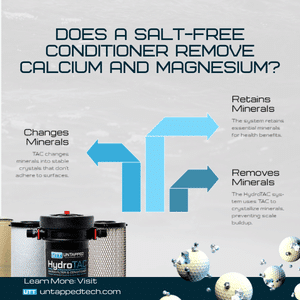 It changes them. Our HydroTAC system uses Template-Assisted Crystallization (TAC). The filter media contains millions of microscopic nucleation sites. As hard water flows over them, dissolved calcium and magnesium attach to these sites to form stable crystals.
These crystals then detach and flow through your plumbing. Since the crystallization process is already complete, they no longer release anything.
They cannot adhere to pipe walls, heating elements, or your kitchen sink aerator; they are simply flushed away with the water. This is how the HydroTAC system prevents up to 99.6% of new scale buildup.
Your water hardness remains unchanged. No discharge is sent to the drain, no ion exchange takes place, and the chemical composition of your water retains the calcium and magnesium your body needs. That is the main advantage of a salt-free softener.
Purchase NowHow Ion Exchange Systems Remove Hardness Minerals
A traditional water softener works differently. Water flows through a bed of sodium-charged resin. The resin exchanges this sodium for the calcium and magnesium present in the water, retaining these minerals until the system’s regeneration phase.
During regeneration, a brine tank flushes the resin with saltwater and discharges the trapped minerals into the drain.
Ion exchange removes minerals. This is why a salt-based softener produces truly soft water, but also why it requires salt refills, a drain line, and regular maintenance.
Softened water has a slightly higher sodium content—an important factor for some households. You can use potassium chloride instead of sodium chloride, although it costs more per bag.
| What you care about | Salt free conditioner (TAC) | Salt based water softener (ion exchange) |
|---|---|---|
| Removes calcium and magnesium | No, it crystallizes them | Yes, it exchanges them out |
| Water hardness after treatment | Tests the same in grains | Tests near zero |
| Scale buildup in pipes and appliances | Prevents up to 99.6% of new scale | Prevents scale, no hardness left |
| Soap scum and soap lather | Small improvement | Clear improvement |
| Brighter laundry and softer towels | Little change | Yes, a common reason people choose it |
| Hard water stains and spotting | Still possible, minerals remain | Largely gone |
| Slippery feel and dry skin complaints | Water feels normal | Slick feel, some report dry skin |
| Salt refills and brine tank | None | Required |
| Sodium added to drinking water | None | Slight increase |
| Brine discharge | None | Sent to sewer or septic |
| Electricity and drain line | Neither | Both |
| Maintenance | Media replacement on a schedule | Salt, resin care, valve service |
Why Your Hardness Test Still Reads Hard
This is a common source of confusion. You install a treatment system on your main water line, test the water a week later, and record the same hardness level as before. Yet, nothing has failed.
A hardness test measures the amount of calcium and magnesium in the water; it cannot indicate the form these minerals take. Since a salt-free system leaves these minerals in the water, the measured value remains unchanged.
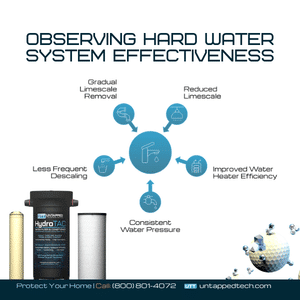 Instead, observe your fixtures and appliances, as that is where the results become apparent.
- Fewer limescale deposits on showerheads, faucet aerators, and kettles
- A water heater that maintains its efficiency instead of losing it under a layer of scale
- Consistent water pressure and flow, thanks to pipes that remain clean
- Coffee makers, ice machines, and instant water heaters that require less frequent descaling
Existing limescale in the piping gradually breaks loose and is flushed out over several months
Since minerals remain in the water, no laboratory test can prove the system’s effectiveness in the same way a hardness test proves the effectiveness of a water softener.
Judge the system’s effectiveness by observing scale formation on your fixtures, rather than by using a test strip.
Purchase NowWhich System Solves Your Hard Water Problems
Choose the system best suited to your specific situation. Limescale and soap scum behave differently; no single product effectively treats both issues simultaneously.
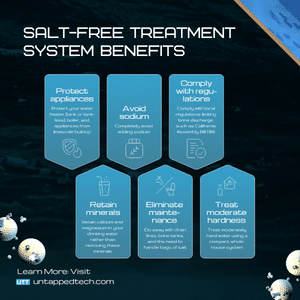 A salt-free treatment system is ideal if you want to:
- Protect your water heater (tank or tankless), boiler, and appliances from limescale buildup
- Retain calcium and magnesium in your drinking water rather than removing these minerals
- Completely avoid adding sodium
- Do away with drain lines, brine tanks, and the need to handle bags of salt
- Comply with local regulations limiting brine discharge (measures now in effect in several municipalities and states, such as California under Assembly Bill 1366)
- Treat moderately hard water using a compact, whole-house system
A salt-based system is more appropriate if you want to:
- Eliminate hard water spots on windows, tiles, and shower enclosures
- Reduce soap scum, get brighter laundry, and use less detergent
- Achieve a near-zero reading on a water hardness test
- Enjoy the characteristic feel of softened water on your skin
Factors influencing your choice: TAC (Template-Assisted Crystallization) technology performs best with clean water. We recommend installing an upstream sediment filter, treating iron and manganese before the system, and reducing chlorine levels with a carbon filter; that is why our system combines a carbon cartridge with the TAC cartridge.
Residential TAC systems are generally suitable for water with a hardness of up to approximately 25 grains (about 430 ppm or mg/L). Private wells with high iron content or very high hardness levels often require a different type of installation. Feel free to send us your water analysis report to receive personalized advice.
Where does reverse osmosis fit in?
These two systems are often confused, but reverse osmosis serves a different purpose. It removes dissolved solids at the point of use—typically a kitchen tap—providing you with higher-quality drinking water for cooking and consumption.
This system treats a few liters of water per day, rather than the entire home’s supply.
A whole-house salt-free water softener protects your plumbing and appliances. Many households use both systems: a softener on the main water line to eliminate limescale, and a reverse osmosis system at the tap to improve taste. The two systems complement each other.
1-561-249-8361How Our HydroTAC Conditioning System Works
HydroTAC treats water where it enters your home, so every fixture downstream benefits. Carbon first reduces chlorine, taste, and odor.
The TAC stage then crystallizes hardness minerals so they stop building scale. No salt, no brine tank, no drain line, no electricity, and a footprint small enough for a tight utility closet.
| HydroTAC component | Price |
|---|---|
| HydroTAC system | $595 |
| Carbon cartridge | $90 |
| TAC cartridge | $170 |
| Carbon and TAC combo pack | $250 |
| Antimicrobial cartridge | $119 |
| Flex connector, 2-pack | $36 |
We supply the system and the replacement cartridges. UnTapped Technologies does not install. Your own licensed plumber fits the unit, which keeps the work local and keeps code compliance and your plumbing warranty in their hands.


Not sure which system your water needs?
Send us your hardness levels and tell us what you want to protect. We will point you to the right solution, even when that means a salt based system instead of ours.
So when a neighbor asks does a salt free conditioner remove calcium and magnesium, tell them it does not remove them at all, it crystallizes them so they cannot build scale while your water keeps the minerals it started with.
Frequently Asked Questions
Does a salt free water conditioner make soft water?
No. Soft water means the calcium and magnesium came out, and only ion exchange does that. A salt free conditioner conditions the water so hardness minerals cannot form scale. Products sold as salt free softeners are conditioners.
Will my water hardness test change after I install a salt-free system?
No. The reading stays about the same, because the minerals stay in the water. That result is normal and does not mean the system failed.
Does a salt free conditioner stop hard water stains?
Not reliably. Stains form when water evaporates and leaves minerals behind on the surface, and those minerals remain. Salt-free systems target scale inside pipes and appliances.
Can a conditioning system clear scale that already built up?
Often yes, slowly. Conditioned water stops adding new scale, and testing shows existing deposits breaking down and washing away over a period of months.
Is salt free water better for drinking?
Many people think so. It adds no sodium and keeps naturally occurring calcium and magnesium. If you watch your sodium intake or want to keep minerals in the water, a salt-free conditioner suits you better than a traditional softener.
Does a salt free system waste water or affect water pressure?
No wastewater at all, because nothing regenerates. Size the unit to your household flow rate and you will not notice a pressure change.
How often does the media need replacing?
TAC media lasts for years in normal residential use when a sediment filter and carbon protect it. The carbon cartridge ahead of it gets changed more often, and a combo pack covers both.
Does a salt free conditioner help with dry skin?
Probably not. People who blame hard water for dry skin usually notice the biggest difference with a salt based softener, since that system removes the minerals rather than crystallizing them.
1-561-249-8361