
How does template assisted crystallization work to prevent scale, and does it really beat a salt softener?Start with what hard water does to your home.
 White spots appear as your freshly washed glasses dry, scale builds up inside the kettle, the shower screen never looks perfectly clean, and eventually, the water heater becomes noisier and more expensive to run.
All of this stems from a single cause. The calcium and magnesium in the water, which precipitate and harden on any surface they touch.
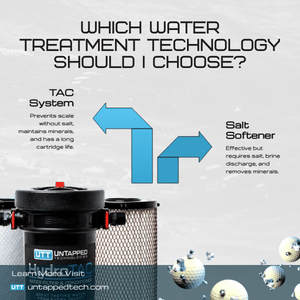
For decades, the only real solution was the salt-based water softener. While effective, this system requires hauling bags of salt every couple of months, discharging brine into the plumbing, and stripping beneficial minerals from your drinking water in the process. Many homeowners want to eliminate limescale without these drawbacks.
This is where Template Assisted Crystallization (TAC) comes in. It is the technology used in our HydroTAC system; it achieves the same result by taking a completely different approach.
Below, we explain how the process works, the findings of independent tests, the technology’s limitations, and the criteria for determining whether it is right for your home or if a traditional softener would be a better fit.
- 99.6% – Scale prevention, tested
- 10 GPM – Whole house flow rate
- 250,000 gal – TAC cartridge life
- 0 lbs – Salt used per year
How Does Template Assisted Crystallization Work to Prevent Scale Inside Your Pipes?
Hard water contains dissolved minerals, such as calcium and magnesium. These minerals—which cause hardness—remain invisible while the water is flowing, but heat and pressure fluctuations cause them to precipitate.
 They then attach to the nearest surface as calcium carbonate; this is the whitish limescale deposit you scrape off your shower walls and find encrusted on your water heater’s heating elements.
Matrix-assisted crystallization (or assisted nucleation crystallization) shifts this reaction to a harmless location. We provide the hardness-causing ions with a surface to latch onto that is preferable to your piping.
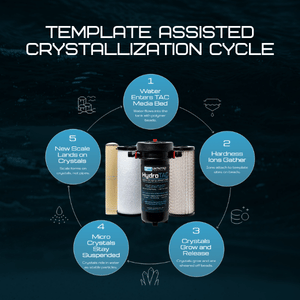
- Water enters the TAC media bed. The tank holds polymer beads. Their surface carries millions of template sites, and each one is a microscopic pocket shaped to attract calcium and magnesium ions.
- Hardness ions gather at the template sites. The ions leave solution and lock into an ordered structure at each site. This is the crystallization step that gives the process its name.
- Crystals grow, then release. The crystals grow until they hit a certain size, then normal flow shears them off the bead. Each template site clears itself and starts again, which is why TAC systems never need regeneration cycles.
- Micro crystals stay suspended. The released seeds ride along in the water as stable particles. They have already crystallized, so they no longer stick to anything.
- New scale lands on the crystals, not your plumbing. Those suspended micro crystals offer far more surface area than your pipes do. Any remaining hardness that wants to form scale deposits on them instead and washes down the drain.
Your water keeps its mineral content and its taste. We add no salt, no chemicals, and no sodium ions, and the system produces no waste water at all.
What Scale Prevention Looks Like Day to Day
- Less limescale buildup on faucets, shower glass, and kettles
- Fewer white spots on glassware and fixtures
- Cleaner heating elements in water heaters, dishwashers, and coffee makers
- Steadier flow rates as pipes stop narrowing from scale buildup
Wondering whether TAC suits your water chemistry? We will tell you straight. Call 1-561-249-8361
Template Assisted Crystallization vs a Conventional Water Softener
A traditional water softener and a TAC water conditioner address the same problem in opposite ways. Salt-based softeners use ion exchange to remove calcium and magnesium ions and replace them with sodium ions.
The TAC process, on the other hand, leaves the minerals in place but alters their form. Understanding this difference can help you save money and avoid purchasing an unsuitable water treatment solution.
| Feature | Template Assisted Crystallization (TAC) | Ion Exchange Softeners |
|---|---|---|
| What happens to hardness | Converts it into micro crystals | Removes hardness ions and adds sodium |
| Salt | None, a true salt free option | Ongoing salt purchases |
| Regeneration cycles | None | Regular, on a timer or meter |
| Brine discharge and water waste | None | Brine discharge to drain each cycle |
| Healthy minerals in drinking water | Calcium and magnesium stay in | Both removed |
| Maintenance burden | Low maintenance, media replacement only | Salt refills, cleaning, valve service |
| Environmental impact | No waste water and no salt in the waste stream | Salty waste water, restricted in some areas |
| Soft, slippery water feel | No | Yes |
| Best for | Preventing limescale formation and scale buildup | Wanting to genuinely soften water |
Set Your Expectations Here
A hardness test still reads hard after a TAC system, and that is the point. TAC prevents scale formation. It does not remove hardness ions. If you want the slick feel of softened water or a lower hardness number on paper, you want a conventional water softener instead, and we would rather tell you that now.
Does the Technology Hold Up Under Testing?
Independent researchers have put the salt free technologies side by side. The most cited work comes from Arizona State University, where a team tested each one using a protocol based on the German DVGW W512 standard, pumping water through an electrically heated reservoir for 20 days and then weighing the calcium precipitate left on the heating element and the walls.
You can read the mechanism and the testing background in this continuing education course on template assisted crystallization written for the building trades.
Template assisted crystallization won by a wide margin. Here is what each technology left behind, measured in grams of calcium carbonate.
| Technology Tested | Scale Formed | Reduction vs Untreated |
|---|---|---|
| Template assisted crystallization | 0.3 g | About 96 percent |
| Capacitive deionization | 1.4 g | About 83 percent |
| Electrically induced precipitation | 4.1 g | About 51 percent |
| Electromagnetic treatment | 4.9 g | About 42 percent |
| Untreated control | 8.4 g | None |
Scale Formed by Treatment Technology
Grams of calcium carbonate collected after 20 days in the Arizona State University trial. Shorter is better.
View these figures as a relative ranking rather than a certification; the researchers themselves clarified that they used efficiency factors for the comparison, without applying the full set of DVGW certification criteria. The ranking is what matters, and TAC clearly outperformed all other salt-free solutions.
According to our product documentation, HydroTAC demonstrates up to 99.6% efficiency in preventing new scale deposits. A figure based on independent testing of our filter media.
We recommend viewing this figure in the context of the ASU data mentioned earlier rather than in isolation, as results depend on your water’s chemical composition (hardness, temperature, dissolved solids, and flow rates).
Continuing education courses for building professionals describe the same mechanism we have outlined; it is therefore an established scientific principle in water treatment, not merely a marketing claim.
This efficiency also impacts your gas bill. Since scale acts as an insulator on the heat exchanger, a scale-encrusted water heater consumes more fuel to transfer heat through that layer of limescale.
Eliminating this buildup can reduce flue gas temperatures by 30% or more in gas systems; the burner consequently works less hard to produce the same amount of hot water.
HydroTAC by the Numbers
Here is what the system actually does, with no rounding in our favor.
| Specification | HydroTAC |
|---|---|
| Scale prevention | Up to 99.6 percent of new scale buildup |
| Service flow rate | 10 gallons per minute, enough for a whole house |
| TAC cartridge life | 3 years or 250,000 gallons |
| Carbon cartridge life | 1 year or 50,000 gallons, 20 micron radial flow |
| Antimicrobial cartridge life | Up to 75,000 gallons |
| Size and weight | 9 by 9 by 18 inches, 16.6 lbs |
| Electricity | None |
| Drain line and waste water | None required |
| Salt used per year | Zero pounds |
| Fits | Houses, townhomes, and condos |
When comparing this system to a salt-based water softener, homeowners notice the difference in operating costs. According to market figures, a conventional softener costs between $700 and $3,500 for the unit alone, and between $1,200 and $3,800 including installation; on top of this, salt refills are required every 6 to 8 weeks, amounting to an annual cost of $300 to $800.
The HydroTAC system costs $595, and routine maintenance is limited to a $90 carbon cartridge, as the TAC cartridge only needs replacing every three years.
Since prices vary depending on the region and water hardness, consider these price ranges for softeners as rough estimates rather than firm quotes.
Ready to stop scale before it starts? The HydroTAC system ships for $595. Talk to Us First
When TAC Is Not the Right Fit
 TAC media needs reasonably clean water to work. A few conditions get in the way.
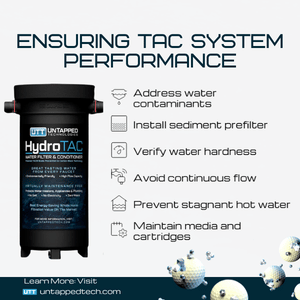
- Iron and manganese. They coat the media and block the template sites. Treat them before the water reaches the TAC tank.
- Sediment. Grit covers the bead surface and cuts performance, so run a sediment prefilter.
- Extremely hard water. TAC media in residential applications is commonly specified up to about 25 grains per gallon. Above that, size the system up or look at other options.
- Long continuous flow. Irrigation and pool fill lines run for hours at high volume and do not suit a residential unit.
- Water that sits hot for long stretches. Stagnant heated water gives scale more chance than the crystals can outcompete.
Look after those points and the media lasts for years. In our system, media replacement comes due at 3 years or 250,000 gallons, whichever you reach first, and the carbon cartridge changes yearly at 50,000 gallons. There is no salt to buy, no brine tank to clean, and no regeneration to schedule.
When TAC Is Not the Right Fit
TAC media requires relatively clean water to function effectively. However, certain factors can impair its performance:
- Iron and manganese. These coat the media and block nucleation sites. They should be treated before the water reaches the TAC tank.
- Sediment. Solid particles coat the surface of the beads and reduce performance; installing a sediment pre-filter is therefore recommended.
- Extremely hard water. For residential applications, TAC media is generally recommended for hardness levels up to approximately 25 grains per gallon. Beyond this level, a higher-capacity system or alternative solutions should be considered.
- Prolonged continuous flow. Irrigation and swimming pool filling systems operate for hours at high flow rates and are not suitable for residential units.
- Stagnant hot water. When hot water sits stagnant for extended periods, scale has more opportunity to form, potentially overwhelming the system’s crystal inhibition capacity.
With these factors in mind, the media can last for several years. In our system, media replacement is scheduled after 3 years or 250,000 gallons of treatment (whichever comes first), while the carbon cartridge must be changed annually or every 50,000 gallons.
No salt purchases or brine tank cleaning are required, and no regeneration cycles need to be programmed.
What Scale Prevention Costs Per 1,000 Gallons
Most water conditioners price their tac media by the liter, which tells you nothing useful. We rate every cartridge in gallons, so you can work out exactly what your water costs to protect. Divide the cartridge price by its rated life and the picture gets clear fast.
| Cartridge | Price | Rated Life | Cost Per 1,000 Gallons |
|---|---|---|---|
| TAC scale prevention | $170 | 250,000 gallons | $0.68 |
| Carbon, 20 micron radial flow | $90 | 50,000 gallons | $1.80 |
| Antimicrobial | $119 | 75,000 gallons | $1.59 |
Cost Per 1,000 Gallons by Cartridge
List price divided by rated gallon capacity. Lower means cheaper water.
Scale prevention costs you 68 cents per 1,000 gallons. When the carbon cartridge is added, the cost of each gallon of filtered, scale-free water comes to approximately $2.48 per thousand gallons.
That represents the entire maintenance cost, as there are no regeneration cycles, no salt, and no wastewater-related fees.
Five Year Cost Against a Traditional Water Softener
Up front price hides the real gap. Salt based water softeners keep charging you every month, and a conventional water softener needs installation on top. Here is how five years actually breaks down.
| System | Up Front | Media or Salt Over 5 Years | 5 Year Total |
|---|---|---|---|
| HydroTAC whole house | $595 | $620 | $1,215 |
| Competing TAC system, 12 GPM | $1,029 | $699 | $1,728 |
| Traditional water softener, installed | $2,500 | $2,750 | $5,250 |
Five Year Cost of Ownership
What you pay up front plus everything the system needs over five years. Shorter is better.
Our five-year estimate includes replacing the filter media in the third year and a carbon cartridge annually.
This cost is approximately 77% lower than that of a salt-based water softener; as for the competing TAC system shown in the center column, it treats water without filtering it, thus requiring a separate carbon filtration step to match the performance of the HydroTAC.
The figures for water softeners are based on market averages (where prices range from $1,200 to $3,800, including installation, plus $300 to $800 annually for salt); the final quote will therefore depend on your water’s chemical composition and the chosen installer.
Want the math run against your own water and household size? Call 1-561-249-8361!
We supply the equipment. We do not install it. Your own licensed plumber fits the system, which keeps the work in line with your local code and protects your plumbing warranty.
Not Sure Which System Your Water Needs?
Call us at 1-561-249-8361 and tell us about your water. We will walk you through your options honestly, because once you understand how does template assisted crystallization work to prevent scale, you can tell in minutes whether HydroTAC suits your home or whether a traditional water softener serves you better.
Frequently Asked Questions
Does TAC Remove Calcium and Magnesium From My Drinking Water?
No. It leaves both minerals in and only changes their physical form, so you keep the healthy minerals that ion exchange takes out.
Is a TAC Unit the Same Thing as a Salt Free Water Softener?
People use the terms interchangeably, and the marketing usually says salt free water softener. Technically these are water conditioners, because they condition the water rather than soften it.
Will My Water Feel Slippery?
No. Template assisted crystallization does not change how the water feels, since the mineral content stays the same.
Can It Clear Scale Buildup That Is Already There?
Some existing deposits do dissolve slowly once the water stops depositing fresh scale at the pipe wall. Count it as a bonus over months, not a descaling service.
Does It Need Electricity, Salt, or a Drain?
None of the three. The process runs on contact alone, which is what keeps maintenance and environmental impact so low.
How Do I Check That It Works?
Not with a hardness test, because the minerals stay in the water. Judge it by what you stop seeing, which means fewer white spots, less crust on fixtures, and appliances that last longer.
