
Almost every week, homeowners ask us about the difference between a conventional water softener and HydroTAC; the answer comes down to a single point. A traditional softener removes the minerals responsible for hardness from the water.
HydroTAC, on the other hand, keeps these minerals in the water while preventing them from forming scale. Both methods protect your plumbing, but they do so in completely different ways; this distinction affects maintenance, operating costs, and the quality of the water coming out of your tap.
1-561-249-8361What sets HydroTAC apart from a normal water softener?
A normal water softener uses salt, resin beads, and an ion exchange process to remove calcium and magnesium ions from hard water. HydroTAC is a salt free water conditioner. It uses template assisted crystallization to turn hardness minerals into microscopic crystals that cannot form scale, so you keep the beneficial minerals and skip the brine tank.
What Is the Difference Between a Normal Water Softener and HydroTAC in How They Work?
The Ion Exchange Process Inside a Salt Based Water Softener
A traditional water softener uses two tanks. The resin tank contains thousands of resin beads charged with sodium ions. The brine tank holds the salt that you must replenish regularly.
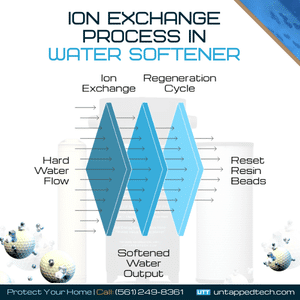 As hard water flows through the resin tank, the beads exchange their sodium ions for the calcium and magnesium ions present in the water. This exchange constitutes the ion exchange process; it physically removes the minerals responsible for water hardness.
The result is softened water. Soap lathers easily, and your dishes are free of streaks or limescale spots on the glass.
The trade-off is the regstay free of streaks and limescale spotseneration cycle. Once the resin beads are saturated with minerals from the hard water, the system rinses them with brine to reset them. A salt-based system requires a drain line for this rinsing, an electrical outlet for the control valve, floor space for two tanks, and a supply of salt.
Template Assisted Crystallization Inside the HydroTAC System
HydroTAC uses no salt. Hard water first passes through a 20-micron carbon block, then through the TAC cartridge. At this stage, the minerals responsible for scale formation attach to the treatment media and form microscopic crystals.
These crystals remain suspended and circulate through the pipes instead of adhering to them; scale formation is thus halted before it even begins. HydroTAC is up to 99.6% effective at preventing new scale buildup on your appliances, while preserving beneficial minerals such as calcium and magnesium in the water.
Since the system does not remove any minerals, it requires no regeneration cycle, chemicals, drain connection, or power supply. The mineral content remains unchanged, and the chemical composition of your water undergoes very little alteration.
Purchase NowSide-by-Side Comparison of Salt Based Softeners and the Salt Free Conditioner
Traditional water softener compared with the HydroTAC salt free system
| What Matters | Salt Based Water Softener | HydroTAC Salt Free Water Conditioner |
|---|---|---|
| Method | Ion exchange with resin beads | Template assisted crystallization |
| Removes hardness minerals | Yes, calcium and magnesium come out | No, hard minerals stay in the water |
| Salt | Ongoing bags of salt | None, this is salt free water |
| Sodium ions added | Yes | No |
| Brine tank | Required | Not used |
| Regeneration cycle | Required | None |
| Drain line | Required | No drain connection needed |
| Electrical outlet | Required for the control valve | No electrical power needed, so no added energy costs |
| Scale buildup | Prevented by removing the minerals | Up to 99.6% effective in preventing new scale buildup |
| Beneficial minerals | Removed | Calcium and magnesium stay in the water |
| Water quality extras | A softener alone does not filter | Carbon block reduces chlorine, taste, odor, sediment, and common contaminants including PFAS chemicals |
| Feel of the water | Slippery softened water, heavy soap lather | Feels close to untreated water since nothing is removed |
| Size | Two tanks, often several feet tall | Compact size, 9 x 9 x 19.2 in, 17 lbs |
| Flow rate | Varies by unit | Maximum 10 gpm, 37.8 lpm |
| Upkeep | Salt refills, brine tank cleaning, valve service | Low maintenance, two cartridge swaps, about as long as changing a lightbulb |
Not sure which column your home falls into? Send us your numbers and we will read them with you. Get a Free Water Test!
What HydroTAC Actually Includes
HydroTAC is one compact unit rather than a two tank water softening system. Inside it, two stages handle two different jobs.
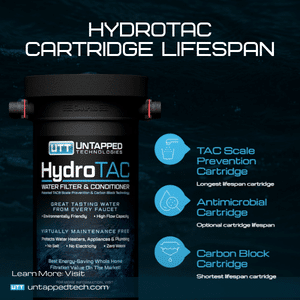 20 micron radial flow carbon block. Water passes through this filtration stage first. It reduces chlorine content, sediment, and discoloration, while eliminating unpleasant odors and tastes, as well as chemicals (such as PFAS) and other common contaminants. This filter must be replaced after one year of use or after treating 50,000 gallons (approximately 189,000 liters) of water.
- TAC scale prevention cartridge. This is the conditioning medium that transforms water-hardening minerals into crystals; these crystals can no longer form scale on your water heater, faucets, or water-using appliances. This cartridge has a lifespan of up to 3 years or 250,000 gallons (approximately 946,000 liters).
An optional antimicrobial cartridge is also available; it uses NASA-derived technology and can treat up to 75,000 gallons (approximately 284,000 liters) before requiring replacement.
Combining these two standard stages offers a more comprehensive solution than a conventional softener, which is limited to treating water hardness.
Operating Conditions To Check First
The HydroTAC is designed for a maximum hardness of 75 grains per gallon, a pressure range of 10 to 90 psi, and temperatures between 40 and 104°F (approximately 4 to 40°C). It is intended for indoor use. This system is ideal for municipal water; for well water, we recommend a preliminary analysis before ordering.
1-561-249-8361About installation. We supply the equipment. We do not install it. The system ships with everything needed for assembly, and because it needs no drain connection and no electrical power, fitting it is far simpler than fitting a softener. Your own licensed plumber handles the connection at the main line.
What Each System Costs To Run
A salt-based system continues to incur costs after the initial purchase: you must buy salt, water is lost during every regeneration cycle, you pay for the energy needed to operate the valve, and the resin eventually requires maintenance.
In contrast, a salt-free alternative like HydroTAC relies on a fixed maintenance schedule.
HydroTAC pricing, free shipping on all orders
| Item | When | Price |
|---|---|---|
| HydroTAC water treatment system | One time | $595 |
| 20 micron carbon cartridge | 1 year or 50,000 gallons | $90 |
| TAC cartridge | Up to 3 years or 250,000 gallons | $170 |
| Combo pack, both cartridges | When both are due | $250 |
| Antimicrobial cartridge | Optional, up to 75,000 gallons | $119 |
| Flex connector, 2 pack | As needed | $36 |
No salt to buy, no brine tank to scrub, and nothing to program. With a tankless gas water heater, removing scale from the heat exchanger also lowers flue gas temperatures by 30% or more; electric systems likewise achieve significant energy savings for the same reason.
Questions about your own setup before you decide anything? We are happy to talk it through. Ask Us a Question!
Which One Should You Choose?
A Traditional Softener Fits If
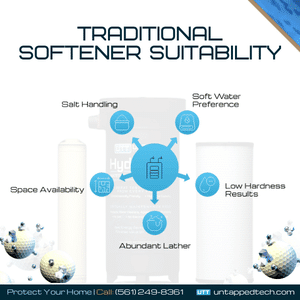 You want truly soft water and the silky feel that comes with it.
- You want test results showing low water hardness.
- Abundant soap lather and spot-free dishes are your top priorities.
- You have the space for two tanks, a drain line, and an electrical outlet.
- You don’t mind buying and hauling salt.
HydroTAC Fits If
- Your main goal is to prevent mineral buildup in your water heater and appliances.
- You want to keep calcium and magnesium in your drinking water while avoiding added sodium.
- You do not have a drain line or electrical outlet at the installation site.
- Space is limited, and you want a compact model.
- You want to prevent limescale and improve water quality with a single, low-maintenance unit.
The Honest Trade Off
The HydroTAC system does not remove minerals; consequently, a hardness test on the treated water will show the same reading as before. This is how the technology works, not a defect in the unit. If you are aiming for a lower hardness level, a salt-based softener is the right solution.
If your goal is to protect your plumbing from limescale without using salt, wasting water, or consuming electricity, the HydroTAC system meets that need directly. It is also important to note that TAC technology differs from magnetic field devices.
Template-Assisted Crystallization (TAC) is a physical process using a specific medium; its effectiveness has been proven and documented.


Still Weighing It Up?
Tell us your water hardness, your household size, and where the unit would go. We will tell you straight whether a salt based softener or HydroTAC suits your hard water problems better.
So when someone asks what is the difference between a normal water softener and HydroTAC, the short version is that a salt based softener removes hardness minerals using salt and a regeneration cycle, while HydroTAC crystallizes those same minerals salt free so scale never gets a chance to form.
Purchase NowFrequently Asked Questions
Is HydroTAC a Water Softener?
Not in the technical sense. Water softeners work by removing hardness minerals through ion exchange. HydroTAC is a water conditioner. It reorganizes those minerals into harmless microscopic crystals that flow down your pipes, with no regeneration and no chemicals.
Will My Water Still Test Hard?
Yes. Calcium and magnesium remain in the water, so the hardness reading stays the same. What changes is that the dissolved minerals no longer stick to pipes, glass, or your water heater.
Do Salt Free Water Conditioners Really Work?
For scale prevention, yes. HydroTAC is up to 99.6% effective in preventing new scale buildup on your appliances. It will not give you the slippery feel of softened water, because it is not removing anything.
Does HydroTAC Add Salt or Sodium to My Water?
No. There is no added salt anywhere in the process, and no chemicals either.
Does It Need a Drain or an Outlet?
Neither. No drain connection and no electrical power are needed, which is why it fits in places a two tank softener cannot.
Will Soap Still Lather Well?
Not as much as with a salt based softener. Softened water lathers more because the hard minerals are gone. Water treated with HydroTAC lathers normally.
How Much Maintenance Is There?
Very little. Changing a filter takes about as much time as it takes to change a lightbulb. The carbon block goes 1 year or 50,000 gallons, and the TAC cartridge lasts up to 3 years or 250,000 gallons.
Does It Work on Well Water?
HydroTAC is best suited to municipal water. If you are on a well, we ask for a water analysis first so we can tell you honestly whether it is the right fit.
How Much Does It Cost?
The system is $595 with free shipping. After that, a $90 carbon cartridge and a $170 TAC cartridge on the schedules above.
