
What Are The Health Benefits Of Keeping Minerals In Drinking Water, And What Does A Softener Take Out?
Drinking mineral-rich water supplies essential calcium and magnesium which strengthen bones, support heart health, and aid muscle function while delivering a crisp taste. For example, a water sample with 180 mg/L hardness containing 72 mg/L of calcium sits perfectly within the World Health Organization's optimum health range. A water softener will take this to zero. HydroTAC keeps it the calcium and magnesium levels as is.
Homeowners ask us about the health benefits of keeping minerals in drinking water once they learn their softener strips those minerals out. Calcium, magnesium and other trace elements are not contaminants.
They are essential minerals the human body needs daily, and your drinking water delivers them in a form that absorbs easily.
This guide covers what the research shows, how much mineral content your tap water carries, and what a softener actually swaps into your glass.
The Health Benefits Of Keeping Minerals In Drinking Water Start With Mineral Content
Natural mineral water derives its mineral composition from the underground environment. Rainwater filters through rock to form natural underground reservoirs and mineral springs, dissolving calcium, magnesium, potassium, bicarbonate, and other trace elements along the way.
 Bottled water companies market this product as natural spring water. Municipal tap water passes through the same geological formations, which explains the significant variations in mineral content from one city to another.
These essential minerals are important because the human body cannot synthesize them. We obtain them through our diet, supplements, and drinking water. While water is not the primary source, WHO researchers highlight an important point regarding this.
The minerals in water are already dissolved, which promotes optimal absorption and distributes intake throughout the day, rather than concentrating it in a single meal.
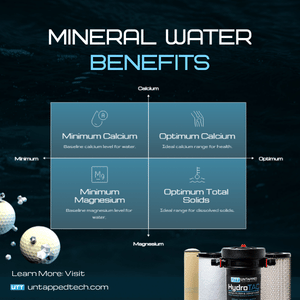
- 20 mg/L – WHO minimum calcium in drinking water
- 40 to 80 mg/L – Optimum calcium range
- 10 mg/L – WHO minimum magnesium
- 250 to 500 mg/L – Optimum total dissolved solids
Your Tap Water Probably Already Hits The WHO Optimum
Here is an aspect almost no one considers. On your water quality report, hardness is expressed as calcium carbonate; to convert it to actual calcium content, apply a factor of about 0.4.
After this conversion, most Florida households find their tap water already falls within the range deemed optimal by the WHO.
Calcium in drinking water after treatment, by incoming hardness.
A Softener Takes Your Calcium Out Of The WHO Optimum Band
Calcium in drinking water after treatment, by incoming hardness (mg/L)
incoming hardness 180 mg/L
incoming hardness 250 mg/L
incoming hardness
| Hardness On Your Water Report | Calcium In Your Water | Against The WHO 40 To 80 mg/L Optimum | Calcium After A Softener | Calcium After HydroTAC |
|---|---|---|---|---|
| 120 mg/L | 48 mg/L | Inside the optimum band | Near zero | 48 mg/L |
| 180 mg/L | 72 mg/L | Inside the optimum band | Near zero | 72 mg/L |
| 250 mg/L | 100 mg/L | Above optimum, still beneficial | Near zero | 100 mg/L |
A salt based softener takes a household from the WHO optimum calcium range to near zero. HydroTAC leaves your water where WHO wants it.
You can check this yourself. Pull the hardness figure from your utility’s annual water quality report and multiply by 0.4.
The Sodium A Softener Adds To Your Glass
Ion exchange does not simply remove calcium and magnesium. It trades them for sodium, ion for ion, at a fixed rate of roughly 7.85 mg per liter for every grain per gallon of hardness removed.
That trade rarely appears on a sales sheet, so we ran it for a real household.
Municipal hardness, worked example. 180 mg/L as calcium carbonate Converted to grains per gallon. 180 ÷ 17.1 = 10.5 gpg Sodium added by ion exchange. 10.5 × 7.85 = 82 mg/L At two liters of drinking water a day. About 165 mg of added sodium per person, per day
Milligrams per person per day, by incoming hardness. HydroTAC adds 0 mg at every level.
Sodium A Softener Adds To Two Liters Of Drinking Water Daily
Milligrams per person per day, by incoming hardness. HydroTAC adds 0 mg at every level.
| Incoming Hardness | Grains Per Gallon | Sodium A Softener Adds | Added Sodium At 2 L Daily | Sodium HydroTAC Adds |
|---|---|---|---|---|
| 120 mg/L | 7.0 | 55 mg/L | 110 mg | 0 mg |
| 180 mg/L | 10.5 | 82 mg/L | 165 mg | 0 mg |
| 250 mg/L | 14.6 | 115 mg/L | 230 mg | 0 mg |
| 340 mg/L | 19.9 | 156 mg/L | 312 mg | 0 mg |
With water hardness of 250 mg/L, a person consuming two liters of softened water daily ingests approximately 230 mg of additional sodium—nearly 10% of the 2,300 mg daily limit—simply by drinking that water.
Anyone with high blood pressure who is on a low-salt diet should be aware of this figure before purchasing a water softener.
Want to know what your current system takes out and puts in? We will walk you through your water report in five minutes. Call Us At 1-561-249-8361!
Bone Health And Calcium Intake From Calcium Rich Water
Bone strength depends on a steady intake of calcium over several decades, and calcium-rich mineral waters contribute to this.
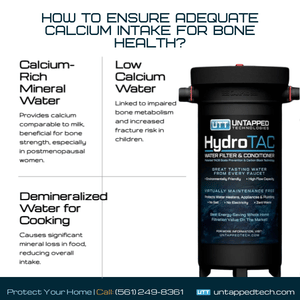 Researchers publishing in the American Journal of Clinical Nutrition measured the bioavailability of calcium in mineral waters and found it comparable to that of calcium in milk. As far as your skeleton is concerned, it makes no difference whether the calcium comes from a glass or a carton.
This effect is particularly pronounced in postmenopausal women, the group most at risk of declining bone density. In a study published in Osteoporosis International, women with low calcium intake saw a decrease in biochemical markers of bone remodeling after consuming calcium-rich mineral water, indicating reduced bone resorption.
The WHO also highlights the reverse phenomenon: water low in calcium has been linked to impaired bone metabolism and an increased risk of fractures in children.
Another surprising fact is that cooking food in demineralized water causes a loss of the minerals naturally present in the food itself. The WHO reports losses of around 60% for calcium and magnesium, and even higher for certain other trace elements. The water used to cook your pasta therefore alters your mineral intake.
Blood Pressure And Heart Health
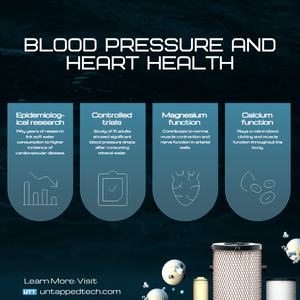
Fifty years of epidemiological research, summarized by the WHO, establish a link between the consumption of soft water—low in calcium and magnesium—and a higher incidence of cardiovascular disease compared to the consumption of hard water.
 This association has been observed at the population level rather than proven for any specific individual; we should therefore avoid overstating it.
Controlled trials provide further insight. A study published in BMC Public Health tracked 70 adults with borderline high blood pressure who consumed at least one liter of natural mineral water daily for four weeks.
Participants who initially had low urinary levels of magnesium and calcium showed a significant drop in both systolic and diastolic blood pressure as early as the second week. T
Those whose magnesium intake was already adequate saw no change, indicating that the observed benefit stems from addressing a deficiency rather than the presence of a “miracle ingredient.”
Magnesium contributes to normal muscle contraction and nerve function, particularly in the muscles of the arterial walls. Calcium plays a role in blood clotting and muscle function throughout the body.
These are essential functions, and a deficiency in either element is unlikely when the solution is free of charge.
Hydration And Electrolyte Balance
Water carries electrolytes, which govern how your body moves fluids between its various compartments. Sodium, potassium, calcium, and magnesium regulate body fluids, nerve signal transmission, and muscle function.
Consuming mineral water rich in these elements promotes better hydration and electrolyte balance than completely demineralized water. A crucial factor after heavy sweating in the Florida heat.
The WHO highlights the opposite effect. Water very low in minerals increases urine production and leads to the body losing more sodium, potassium, calcium, and magnesium. You drink more, but retain less.
Digestive Health And Magnesium
Magnesium draws water into the intestine, softening the stool and helping intestinal muscles move it along. Clinical studies confirm this effect.
A randomized, double-blind trial involving a natural mineral water rich in magnesium sulfate—conducted on adults suffering from functional constipation—found that 37.5% of participants in the treatment group responded to the treatment by the second week, compared to 21.1% in the placebo group, with an average response time of 6.4 days.
Stool consistency improved without an increase in the number of loose stools.
The waters used in these studies have a very high mineral content, exceeding 2,500 mg/L of dry residue; ordinary tap water will therefore not yield an equivalent result. However, this mechanism remains relevant for daily digestive health: the magnesium in your water works in your favor, not against you.
Carbonated Mineral Water, Bottled Water And Tap Water Compared
People often reach for bottled mineral water to get these potential health benefits. That works, and it also costs money and creates waste.
| Source | Mineral Profile | Practical Notes |
|---|---|---|
| Bottled mineral water | Defined mineral content, often high in calcium or magnesium | Sold in plastic bottles or glass bottles, expensive per liter for a whole household |
| Naturally carbonated mineral water | Minerals plus dissolved carbon dioxide from natural springs | Carbonated water suits people who dislike flat water, and removing carbon dioxide simply flattens it |
| Tap water on a softener | Calcium and magnesium removed by ion exchange | Adds sodium in proportion to incoming hardness |
| Tap water on reverse osmosis | Nearly all minerals removed | Needs remineralization to restore taste and mineral content |
| Tap water on HydroTAC | Calcium and magnesium retained | Scale controlled with no salt and no sodium added |
Good water filters target harmful contaminants such as chlorine, sediment and taste and odor problems while leaving the beneficial minerals alone. That distinction is worth understanding before you buy anything.
How HydroTAC Compares On Price
Salt free conditioning is not a budget category, so we will show you where our system lands. These are published prices as of September 2026.
| System | Technology | Price | Sodium Added |
|---|---|---|---|
| UnTapped HydroTAC | Template assisted crystallization | $595 | None |
| NuvoH2O Manor | Citric acid chelation | $797.99 | None |
| Kind E-2000 | Template assisted crystallization | $1,263.80 | None |
| SoftPro Elite | Nucleation assisted crystallization | $1,322 | None |
| SpringWell FutureSoft FS1 | Template assisted crystallization | $1,597.31 | None |
HydroTAC gives you the lowest cost of entry in the category at $595, about 63 percent below the SpringWell FutureSoft FS1. We will be straight with you about why.
Larger units bundle bigger tanks and higher flow rates, so call us and we will tell you honestly whether HydroTAC suits your household size.
HydroTAC costs $595, with carbon cartridges at $90 and TAC cartridges at $170. We supply the equipment and your own licensed plumber fits it. Order yours now!
How HydroTAC Keeps The Minerals And Still Stops Scale
A salt-based water softener eliminates limescale by removing calcium. HydroTAC, on the other hand, alters the behavior of calcium.
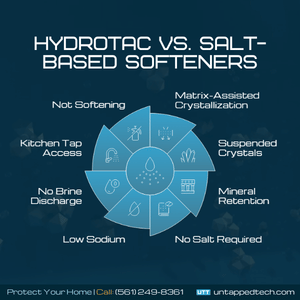 Water flows through a matrix-assisted crystallization medium, which transforms dissolved hardness into microscopic crystals. These crystals remain suspended and flow through your pipes, water heater, and fixtures instead of adhering to them.
Calcium and magnesium remain in the water, ensuring that every glass retains minerals essential to your body.
- No more buying or hauling bags of salt.
- Your drinking water does not become enriched with sodium—a valuable benefit for a low-sodium diet.
- No brine is discharged into your plumbing.
- Your water remains calcium-rich right at the kitchen tap.
Let’s be clear: TAC treatment does not soften water. You won’t experience the rich lather produced by a salt-based softener, because the minerals responsible for hardness remain in the water. You are prioritizing this mineral retention over the specific feel of softened water, while still gaining protection against limescale.
A Real World Example
Picture a household on Florida municipal water measuring 180 mg/L of hardness. On a softener, 72 mg/L of calcium becomes zero and replaced with 82 mg/L of sodium.
On HydroTAC, that same 72 mg/L of calcium reaches the kitchen tap, right inside the WHO optimum band, while the water heater stays clear of new scale. Same source water, two very different glasses.
Key Takeaways Mineral Water Buyers Should Know
- Calcium and magnesium in water arrive as dissolved inorganic compounds, so the human body absorbs them readily.
- The World Health Organization sets a minimum of 20 mg/L calcium and 10 mg/L magnesium in drinking water, with an optimum near 40 to 80 mg/L calcium.
- Typical Florida tap water already sits inside that optimum band. A salt based softener drops it to near zero.
- At 250 mg/L hardness, a softener adds roughly 230 mg of sodium per person daily at two liters, which works against a low sodium diet.
- TAC conditioning stops scale while leaving the mineral composition of your water intact.
Clean water and mineral free water describe two different goals, and the real health benefits of keeping minerals in drinking water are why we built HydroTAC to protect your plumbing without stripping the calcium and magnesium out of your glass.
Frequently Asked Questions
Does Tap Water Really Provide Meaningful Calcium Intake?
Food supplies most of your calcium. Water still adds a useful share. Two liters of drinking water at 72 mg/L contributes about 144 mg of calcium per day, and studies show that calcium absorbs about as well as the calcium in milk.
How Much Sodium Does A Water Softener Add?
About 7.85 mg per liter for every grain per gallon of hardness removed. At 180 mg/L hardness that works out to roughly 82 mg/L, or about 165 mg of added sodium daily for someone drinking two liters.
Is Reverse Osmosis Water Bad For Human Health?
Not by itself. It carries very little mineral content, which is why remineralization stages exist and why WHO raises concerns about long term use of demineralized water for drinking and cooking. Many homes run reverse osmosis at one tap and keep mineral rich water everywhere else.
Does A Water Softener Remove Essential Minerals?
Yes. Ion exchange swaps calcium and magnesium for sodium, so softened water loses the minerals that made it hard and gains sodium instead.
Do Minerals In Drinking Water Cause Kidney Stones?
Higher fluid intake lowers kidney stone risk, and dietary calcium generally does not raise it. Anyone with a history of stones should ask their doctor about their own mineral water intake rather than guessing.
Can I Keep Minerals And Still Avoid Limescale?
Yes, and that describes exactly what TAC conditioning does. Your hardness minerals stay in the water while turning into crystals that will not stick to plumbing.
Does UnTapped Technologies Install The System?
No. We supply the equipment and your own licensed plumber fits it. That keeps the work local, permitted where required, and handled by someone who already knows your plumbing.
