
Can HydroTAC Reduce Existing Scale In Home Plumbing?
Yes, gradually. HydroTAC can reduce existing scale in home plumbing because treated water pulls old deposits loose while it blocks new ones. A homeowner on 12 grain hard water with a rumbling water heater usually sees aerators stop clogging and shower door limescale wipe away with a brush inside 30 to 90 days.
Can HydroTAC reduce existing scale in home plumbing? Plenty of people ask us whether HydroTAC can reduce existing scale in home plumbing, and they almost always ask after they spot the damage. A water heater that pops and rumbles. A shower head that sprays sideways.
Chalky white crust ringing every faucet. That crust is calcium carbonate, and it hardened onto those surfaces long before anyone started shopping for a solution.
We answer this question honestly, because preventing scale buildup and clearing existing scale are two different jobs, and most of this industry blurs the line.
- 99.6% – Of new scale formation HydroTAC prevents
- 30 to 90 – Days in which old scale typically breaks loose
- 10 to 12% – Water heater efficiency lost to a sixteenth inch of scale
- $59.50 – HydroTAC cost per GPM, lowest of four systems we compared
Can HydroTAC Reduce Existing Scale In Home Plumbing? Here Is How It Works
HydroTAC relies on Template-Assisted Crystallization (TAC) technology. The polymer beads inside the system’s core feature microscopic nucleation sites; these capture dissolved calcium and magnesium, transforming them into tiny crystals after just five seconds of contact.
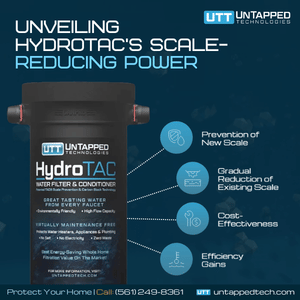 These crystals detach from the beads and circulate through your plumbing system, suspended in the water. They never adhere to pipe walls, heating elements, or fixtures. This process prevents up to 99.6% of scale formation, starting the moment your plumber opens the valve.
Here is the explanation that answers your real question. Hard water arrives at your home already saturated with dissolved minerals; it therefore lacks the capacity to absorb any more. HydroTAC transforms this hardness into crystals and supplies your pipes with water that is no longer saturated.
In this state, the water acts in the opposite way to scale formation. It extracts minerals from the surfaces it touches. It is this shift in water chemistry—rather than the action of an acid or additive—that reduces existing deposits.
Industry players describe this same phenomenon from two different angles. Fresh Water Systems explains that the micro-crystals dislodge existing scale from pipe walls as they flow through.
Watts, a manufacturer of a competing TAC system, informs buyers that old scale accumulated in pipes may break loose within 30 to 90 days of installation. The mechanism differs, but the result and timeframe remain essentially the same. Our own customer experience confirms this.
In short, HydroTAC does not “scrub” your pipes. It alters the water flowing through them, shifting the balance from a phase of scale accumulation to one of scale removal.
One Honest Warning: If your household plumbing has collected scale for fifteen or twenty years, a heavy release can temporarily clog aerators and cloud your water for a few weeks. In rare cases with badly occluded old pipes, enough material lets go at once to cause a genuine blockage. Homes with old galvanized lines should have a plumber look at the pipes before installing any salt-free treatment. That risk is real, it is short lived, and almost nobody in this industry mentions it.
Prevention Versus Reduction, Side By Side
| What You Want | What HydroTAC Does | Timeframe |
|---|---|---|
| Stop new mineral build up | Direct. TAC crystallizes hardness so it flows through instead of sticking | Immediate |
| Reduce existing scale inside pipes and on fixtures | Indirect. Unsaturated treated water lifts older deposits off surfaces | 30 to 90 days |
| Clear limescale in a water heater tank | Partial. The water helps, but settled sediment still needs a flush | Gradual, and no substitute for maintenance |
| Strip minerals out of your drinking water | Not its job. Calcium and magnesium stay in the water and simply stop forming scale | Not applicable |
What Existing Scale Actually Costs You
Limescale buildup is not merely an aesthetic issue. A layer of scale just one-sixteenth of an inch (approximately 1.6 mm) thick on a water heater’s heating element increases energy consumption by about 10–12%, with each additional millimeter driving up usage by nearly another 7%.
Water heaters affected by scale fail prematurely, turning a routine maintenance task into a costly replacement bill. Deposits narrow the internal diameter of pipes and restrict water flow; once the system is severely clogged, you will need to call a plumber.
Hard water insidiously sets the stage for these costly repairs.
| Hard Water Factor | Realistic Number |
|---|---|
| Hardness where visible scale starts | 7 grains per gallon and up |
| Typical Florida municipal and well water hardness | 10 to 20 grains per gallon |
| Efficiency lost to a sixteenth inch of scale in a water heater | 10 to 12 percent |
| Water heater life lost to untreated hard water | 2 to 5 years |
| Extra soap and detergent hard water demands | 25 to 30 percent |
| Scale formation HydroTAC prevents | Up to 99.6 percent |
The Existing Scale Timeline, Day By Day
Here is the whole process on a clock, with the number to watch at each stage. Day 0 is the day your plumber opens the valve.
| Timeframe | What Happens | The Number |
|---|---|---|
| Day 0 | Water hits the TAC media and hardness converts to microscopic crystals. New scale formation stops on contact. | 5 second contact time, 99.6% of new scale blocked |
| Days 1 to 14 | No fresh deposits land on any surface. Spotting and film on glass, tile and fixtures stop getting worse. | 0 new mineral build up on 100% of fixtures |
| Days 14 to 30 | Older limescale starts releasing. Some homes see flakes in aerators or briefly cloudy water. That is deposits leaving, not a fault. | Release begins in most homes above 10 grains per gallon |
| Days 30 to 90 | The main reduction window. Existing scale on fixtures, inside pipes and on heating elements thins out. Water flow through partly blocked fixtures picks back up. | 30 to 90 days, the window Watts publishes for its own TAC system |
| Day 90 and beyond | Your household plumbing holds a clean steady state. A water heater no longer gaining scale stops losing efficiency to it. | Up to 10 to 12% heater efficiency protected per sixteenth inch |
| Month 12 | Replace the carbon block. Scale protection continues uninterrupted. | 50,000 gallons, $90 |
| Year 3 | Replace the TAC cartridge. | 250,000 gallons, $170 |
| Year 5 | Total spend on the system and every cartridge it needed. | $1,125, or $18.75 a month |
Two honest notes on the table. Hardness stays in your water the whole time, because TAC prevents scale rather than removing minerals, so a hardness test at day 90 reads the same as day 0 and soap behaves the way it always has.
And the release stage moves at different speeds in different houses. Results vary with hardness, water temperature, the age of the deposits and how much water the house uses, and a twenty year old galvanized line behaves nothing like a five year old copper run.
What HydroTAC Will Not Do
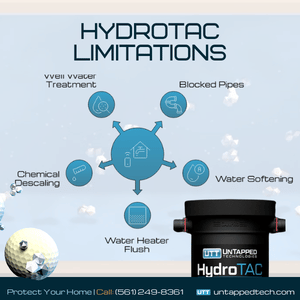 It will not open a pipe that scale already blocked. Heavy occlusion is a plumbing repair, not a water treatment fix.
- It will not soften your water. A hardness test after installation reads the same as before, because TAC skips ion exchange entirely. No salt, no sodium added, no brine tank, no backwash, no wastewater.
- It will not replace a water heater flush. Sediment sitting on the tank floor still needs to come out.
- It will not act as a chemical descaler. HydroTAC adds no acid and nothing else to your water.
- It will not fix a well water problem it was never built for. Iron, sulfur and bacteria each need their own treatment.
How HydroTAC Compares To A Whole House Water Softener
A traditional residential water softener replaces calcium with sodium via ion exchange, consumes salt monthly, discharges wastewater into the drains, and takes up floor space. HydroTAC eliminates all these drawbacks.
Our system combines a patented TAC anti-scale cartridge with a radial-flow activated carbon block. As a result, the same unit that removes scale also reduces chlorine, sediment, odors, and discoloration, while improving the taste of your drinking water at every tap—eliminating the need to rely on a pitcher.
We compared the four leading salt-free systems based on price and rated flow rate—though this comparison does not account for the fact that they are designed for homes of different sizes. A lower flow rate is preferable.
Entry price divided by rated flow rate
US dollars per GPM, entry configuration, September 2026 — lower is better
10 GPM Watts OneFlow Plus
10 GPM FilterSmart FS500
12 GPM SpringWell FS1
12 GPM
Cost over time tells the same story. HydroTAC runs $1,125 across five years with every cartridge included, because we publish all six replacement part prices. Three of the four brands we checked publish an entry price and then stop, which leaves buyers unable to model what the system actually costs to keep running.
| System | Entry Price | Five Year Total |
|---|---|---|
| HydroTAC | $595 | $1,125 |
| Watts OneFlow Plus | $807.94 | Replacement pricing not published |
| FilterSmart FS500 | $1,595 | Replacement pricing not published |
| SpringWell FS1 | $1,597.31 | $1,597.31 |
Full Specification Comparison
UnTapped Technologies scored all four brands on eight things a buyer needs before choosing, using each company’s own website and product pages only. No retailer listings, no review sites. One point per item published, eight points possible.
| Specification | HydroTAC | Watts OneFlow Plus | FilterSmart FS500 | SpringWell FS1 |
|---|---|---|---|---|
| Entry price | $595 | $807.94 | $1,595 | $1,597.31 |
| Cost per GPM | $59.50 | $80.79 | $132.92 | $133.11 |
| Rated flow | 10 GPM | 10 GPM | 12 GPM | 12 GPM |
| Build | Cartridge | Cartridge | Tank | Tank |
| Carbon filtration included | Yes, radial flow block | Yes, radial flow block | No, sediment pre-filter only | No |
| Scale prevention claim | Up to 99.6% | Not published | Up to 99% | Not published |
| Existing scale statement | See this page | Old scale may break loose in 30 to 90 days | Prevents and removes scale | Removes existing scale |
| Scale media life | 3 yr / 250,000 gal | 3 yr | Media not replaced | 6 yr / 1M gal |
| Carbon or pre-filter life | 1 yr / 50,000 gal | 12 months | 8 to 10 months | Not applicable |
| Replacement part pricing published | Yes, all six parts | No | No | No |
| Named third party certification | None published | WQA, NSF/ANSI/CAN 372 | Unnamed body | Unnamed body |
| Physical dimensions published | Yes, 9 x 18 in | Yes, weights and NPT | No | No |
| Salt, electricity or drain line | None required | None required | None required | None required |
| Transparency score | 6 / 8 | 6 / 8 | 5 / 8 | 4 / 8 |
Read that table and three things stand out.
The tank systems cost about twice as much and filter less.
FilterSmart and SpringWell run near $133 per GPM against our $59.50, and neither includes carbon filtration. FilterSmart adds a 5 micron sediment pre-filter, SpringWell adds nothing. Watts is the fair comparison, same cartridge build and same 10 GPM, at $80.79 per GPM.
Nobody in this category names a scale efficacy test.
FilterSmart and SpringWell both describe themselves as certified without naming the certifying body. Watts holds WQA certification and NSF/ANSI/CAN 372 lead free compliance, and neither of those tests scale prevention performance. Our own 99.6 percent figure sits in the same boat, which is why we publish the number and tell you where it comes from rather than waving a badge at you.
We tie Watts rather than beating everyone.
We score 6 out of 8 and so do they. We lose a point for the certification gap above, and until this page went up we lost one for never addressing existing scale. We would rather show you an honest scorecard with two red marks on our own row than a chart where we win every line.
What A Salt Softener Costs Over The Same Five Years
Salt-based systems carry running costs that salt-free systems simply do not have. A typical household burns one 40 pound bag of salt every 4 to 6 weeks, which works out to 520 to 1,040 pounds and $60 to $120 a year.
Each regeneration flushes 25 to 65 gallons down the drain, so a softener wastes 1,300 to 10,000 gallons annually depending on how often it cycles. Add electricity and the total operating cost lands at $85 to $190 per year before you replace a single part.
| Five Year Comparison | HydroTAC | Salt-Based Softener |
|---|---|---|
| Equipment | $595 | $800 to $2,500 |
| Consumables and operating cost | $530 in cartridges | $425 to $950 |
| Five year total, equipment plus running | $1,125 | $1,225 to $3,450 |
| Salt purchased | 0 lbs | 2,600 to 5,200 lbs |
| Water sent down the drain | 0 gallons | 6,500 to 50,000 gallons |
| Electricity | None | Required |
| Carbon filtration included | Yes | No, sold separately |
What The Numbers Say If You Are Shopping Right Now
If you are looking for the lowest cost per gallon of treated water
The HydroTAC system comes out on top among the four models compared, with a cost of $59.50 per GPM (gallon per minute). The Watts OneFlow Plus costs 36% more, at $80.79.
The FilterSmart and SpringWell models both cost around $133—123% more than the HydroTAC for the same level of performance. Over a five-year period, the total cost of the HydroTAC is $1,125 ($225 per year), which works out to approximately $18.75 per month to protect every water outlet in the home.
If you want to know the true long-term cost before buying.
The HydroTAC is currently the only one of the four systems that allows for this calculation. We publish the prices for all six replacement parts. The other three manufacturers list only the initial purchase price; consequently, a buyer cannot estimate costs for years two through five without requesting a quote.
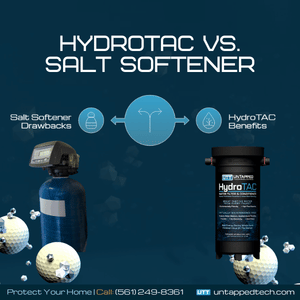 If you are deciding between a salt-free system and a whole-house water softener.
The gap widens over time rather than at the moment of purchase. The HydroTAC sits at the low end of the price spectrum for softeners over a five-year period, while also avoiding the use of 2,600 to 5,200 pounds of salt, the waste of up to 50,000 gallons of water, and the electricity consumption required to operate a softener.
If your main concern is existing scale buildup.
Time is a more important factor than price. Expect new scale formation to stop immediately and existing deposits to diminish over a period of 30 to 90 days; This system will also protect your water heater, which currently loses 10–12% of its efficiency due to a 1/16-inch (approx. 1.6 mm) layer of limescale.
If you have limited utility space
The HydroTAC measures approximately 9 inches wide by 18 inches high—unlike a water softener, which requires a resin tank and a salt bin—and it requires neither a drain nor an electrical outlet.
HydroTAC specifications and pricing
The system treats 10 gallons per minute, requires no electricity, and measures approximately 9 inches wide by 18 inches high, allowing it to be installed in spaces where a water softener would never fit. The TAC cartridge has a lifespan of 3 years or 250,000 gallons, while the activated carbon block lasts up to 1 year or 50,000 gallons. Replacing either component takes about as much time as changing a light bulb, so maintenance is virtually non-existent.
| Item | Price |
|---|---|
| HydroTAC whole home system | $595 |
| TAC scale prevention cartridge, 3 year life | $170 |
| Carbon block cartridge, 1 year life | $90 |
| Combo cartridge pack | $250 |
| Antimicrobial filter | $119 |
| Flex connector, 2 pack | $36 |
One thing to know before you order. We supply the equipment and we do not install it. The system uses John Guest push to connect couplings and flex hoses, and your own licensed plumber fits it to your main water line.
The Bottom Line!
Test your water and read the hardness number. Anything above 7 grains per gallon means scale is forming somewhere in your plumbing right now.
Flush your water heater next, because you want a clean tank before the system goes in. Then let HydroTAC handle the rest and give it the full 90 days to work on what is already present.
Talk To Us About Your Water. Tell us your hardness number and what your fixtures look like, and we will tell you straight whether HydroTAC solves your problem.
Order our HydroTAC Whole-Home System – Water Filter & Conditioner now! Price at $595!
To put it plainly, HydroTAC can reduce existing scale in home plumbing gradually while it blocks new buildup, and the longer it stays on your line the cleaner your pipes, your water heater and your fixtures get.
Frequently Asked Questions
Does HydroTAC Dissolve Scale Already Inside Pipes?
Not chemically. Treated water leaves the cartridge unsaturated with hardness, and that water draws mineral back off surfaces over time. Most existing deposits thin out across 30 to 90 days.
How Long Before I See A Difference In Existing Scale?
New scale stops right away. Older buildup reduces gradually, and most households notice easier cleaning and clearer aerators inside one to two months.
Can Releasing Old Scale Clog My Plumbing?
It can happen in homes with many years of heavy accumulation. Aerators may clog and water may look cloudy for a few weeks. Have a plumber inspect old galvanized pipes before installing.
Should I Descale My Water Heater First?
Yes. Flush the tank before installation. HydroTAC prevents new scale, so a clean start gives you the best performance and the longest heater life.
Will My Water Feel Slippery Like It Does With A Softener?
No. HydroTAC skips ion exchange, so it adds no sodium and your water keeps its natural feel and its minerals.
Is There A Health Risk From The Crystals In My Water?
No. Those minerals were already in your water. HydroTAC only changes their form so they stop sticking to surfaces.
Do I Need A Plumber?
Yes. We supply the system and the fittings, and a licensed plumber connects it to your main line.
