
If you are asking how effective is TAC technology at preventing scale buildup on appliances, you have probably already seen a manufacturer promise 99% and wondered whether anyone outside the industry ever checked.
Fair question. Salt free water conditioning attracts big claims because the hardness minerals stay in your water, which makes results harder to prove than with a traditional water softener that simply removes them.
So we went to the testing instead of the marketing. Below we walk through what university researchers measured, how template assisted crystallization actually changes your water chemistry, what six competing salt free systems charge for the same claim, and the one limitation every buyer should hear before spending money.
- >88% – Scale reduction measured by Wiest and Fox at Arizona State University, up to 99% at 80°C
- >90% – Scale reduction consistently greater than 90% under German standard DVGW W512
- 99.6% – HydroTAC media rating for preventing new scale build up on appliances
- $5.97 – HydroTAC cost per point of scale reduction, against $16.03 for the priciest rival
How Effective Is TAC Technology at Preventing Scale Buildup on Appliances?
Picture a tankless water heater running hard water, where untreated scale coats the heat exchanger and drives energy use up. In WateReuse Foundation testing at Arizona State University, template assisted crystallization cut scale by more than 88%, reaching 99% on the hottest samples. Our HydroTAC media reaches 99.6%.
The Test Data Behind How Effective TAC Technology Is at Preventing Scale Buildup on Appliances
Researchers at Arizona State University ran the study most people cite. In Evaluation of Alternatives to Domestic Ion Exchange Water Softeners, published by the WateReuse Research Foundation, Mara Wiest and Dr. Peter Fox tested several physical water treatment devices against traditional domestic water softeners and against no treatment at all.
They tested three Arizona water sources with hardness minerals from 150 mg/L to 500 mg/L as calcium carbonate, a range that covers ordinary hard water through some of the hardest supplies in the country.
TAC won. The report states that the template-assisted crystallization device was the most efficient device for reducing scale, with greater than 88% scale reduction. On Tempe tap water, the device cut scale by 97% at 60°C and 99% at 80°C, which matters because hotter water forms scale faster, and that is exactly where your water heater operates.
| Test Source | Water Hardness | Result | What It Measured |
|---|---|---|---|
| Wiest and Fox, Arizona State University, for the WateReuse Research Foundation | 150 to 500 mg/L as CaCO3 | Greater than 88%, up to 99% | Scale reduction against untreated controls, 97% at 60°C and 99% at 80°C on Tempe tap water |
| German standard DVGW W512 | Standardized bench water | Greater than 90% | Scale prevention performance, several runs near complete |
| HydroTAC media rating | Manufacturer test | Up to 99.6% | Prevention of new scale build up on appliances |
Independent testing and manufacturer testing land in the same band, which is unusual in this category and a reason to trust the range.
The takeaway
Expect TAC to stop somewhere between 88% and 99% of new scale in a normal home. Your water chemistry decides where in that range you land, and no salt free system guarantees the top of it.
How Template Assisted Crystallization Actually Works
Hard water carries dissolved calcium ions and magnesium ions. When you heat that water or push it through a fixture, those minerals drop out of solution and bond to metal as calcium carbonate. That is scale.
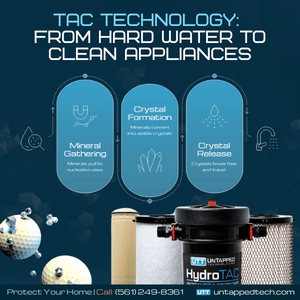 TAC technology, sometimes called nucleation assisted crystallization, uses a highly specialized media consisting of polymer beads covered in treated nucleation sites. Here is what happens as water flows through.
- Water enters the media bed. Hard water carrying calcium and magnesium passes over the treated beads.
- Minerals gather at nucleation sites. The beads pull hardness minerals to their surface instead of letting them stay dissolved.
- Microscopic crystals form. Calcium and magnesium convert into stable micro crystals with crystal structures that cannot form scale.
- Crystals release and travel on. Each crystal breaks free at a set size and gets carried downstream while it remains suspended in the water.
- Your appliances stay clean. Those harmless crystals pass through your heat exchangers, your water heater, and out your tap without sticking to anything.
TAC works by transforming hardness minerals into harmless crystals rather than removing them. That distinction matters for your drinking water.
Salt-free systems keep your beneficial minerals in place, because TAC never uses ion exchange, never swaps calcium ions for sodium ions, and does not remove healthy minerals the way conventional water softeners do.
Your total dissolved solids reading barely moves, and a hardness test still reads hard after treatment. That result is normal and expected with salt free water conditioning.
Want this running in your own home? Our HydroTAC whole home system uses the same TAC media described above, handles 10 GPM peak flow, and needs no salt, no drain, and no electricity.
TAC Technology Compared to Traditional Salt Based Softeners
| Factor | TAC Salt Free Conditioner | Ion Exchange Softener | Reverse Osmosis |
|---|---|---|---|
| Prevents scale buildup on appliances | 88% to 99% | Effectively complete | Point of use only |
| Keeps calcium and magnesium | Yes | No | No |
| Adds sodium or potassium chloride | None | Yes | None |
| Water waste | None | Backwash waste water | High reject ratio |
| Does it require electricity | No | Yes | Usually |
| Soft water feel in the shower | No change | Yes | Not applicable |
| Maintenance | Virtually maintenance free | Salt refills and service | Frequent membrane changes |
| Effect on flow rate | Minimal, 10 GPM peak flow | Moderate | Very low output |
Traditional water softeners still beat salt free options on two specific jobs. They deliver the slippery soft water feel, and they remove calcium entirely so glassware dries spot free. If those two things top your list, buy a softener.
For everything else, salt free water conditioners win on practicality. You skip the salt, the waste water, the drain line, and the power. You protect the same appliances. And you keep the minerals in your drinking water. Homeowners evaluating water softener alternatives usually land on TAC for exactly that trade.
Other salt free water treatment options exist, including electrically induced precipitation and magnetic conditioners, but none of them have produced scale reduction performance close to what TAC treatment technologies show in controlled testing.
What Six Salt Free Water Conditioners Charge for the Same Claim
We compared published list pricing, rated flow, and media life across the salt free market. One finding stood out. Three separate brands publish the identical 99.6% scale reduction figure, and their prices differ by 168%.
| System | Price | Media | Peak Flow | Media Life | Claim | Cost per GPM |
|---|---|---|---|---|---|---|
| HydroTAC | $595 | TAC | 10 GPM | 3 yr / 250k gal | 99.6% | $59.50 |
| US Water GreenWave | $1,484 | NAC | 25 GPM | 4 to 6 yr | 97% | $59.36 |
| SpringWell FutureSoft | $1,597 | TAC | 20 GPM | ~1M gal | 99.6% | $79.85 |
| Kind E-2000 | $1,264 | TAC | 15 GPM | Not replaced | Not stated | $84.27 |
| SoftPro Elite | $1,322 | NAC | 12 GPM | 6 yr | 99.6% | $110.17 |
| Aquasana | $799 | NAC | 7 GPM | ~1M gal | Not stated | $114.14 |
Category average price $1,177. Category average cost per GPM $84.55. Cost per GPM divides list price by rated peak flow, which controls for the fact that higher flow water systems cost more. List pricing at time of writing and it changes often.
Cost per GPM of Flow, Ranked Lowest to Highest
List price divided by rated peak flow. Lower is better.
Scale Prevention per Dollar, the Number Nobody Publishes
Price alone tells you very little, because a $1,597 system that moves 20 GPM is not really more expensive than a $595 system that moves 10. So we built the metric the category is missing. We call it scale prevention per dollar, and it answers one question. If you are looking at this on a per-dollar efficiency basis, how much scale prevention does each dollar actually buy?
How We Calculate It
Scale prevention per dollar multiplies claimed scale reduction by rated peak flow, then divides by list price. A system earns a higher score by preventing more scale, moving more water, or costing less. We index the result against the top performer at 100. Systems that publish no scale reduction figure are excluded, because there is nothing to measure.
| System | Claim | Peak Flow | Price | Cost per Point of Scale Reduction | Per Dollar Index |
|---|---|---|---|---|---|
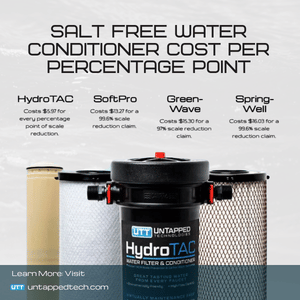
| HydroTAC | 99.6% | 10 GPM | $595 | $5.97 | 100 |
| US Water GreenWave | 97% | 25 GPM | $1,484 | $15.30 | 97.6 |
| SpringWell FutureSoft | 99.6% | 20 GPM | $1,597 | $16.03 | 74.5 |
| SoftPro Elite | 99.6% | 12 GPM | $1,322 | $13.27 | 54.0 |
Cost per point of scale reduction divides list price by the claimed percentage. Per dollar index scores claimed reduction multiplied by rated flow, divided by price, indexed to the leader. Kind E-2000 and Aquasana publish no scale reduction figure and are excluded.
Scale Prevention per Dollar, Indexed
Claimed scale reduction times rated flow, divided by price. Higher is better, leader set to 100.
The finding. HydroTAC costs $5.97 for every percentage point of claimed scale reduction. The next cheapest system on that measure costs $13.27, which is more than double, and SpringWell costs $16.03, nearly triple. On a per dollar efficiency basis, GreenWave runs us close at 97.6 because of its 25 GPM flow, while SoftPro Elite delivers barely half the scale prevention per dollar that HydroTAC does.
Read that fairly, and it cuts both ways. GreenWave earns its score honestly, and if your home genuinely needs 25 GPM, it is the better buy. Our advantage sits with normal households, where 10 GPM covers peak flow, and paying for 20 or 25 buys capacity you will never use.
Claimed scale reduction across these six water conditioners spans under three points, from 97% to 99.6%. Price spans 168%. Effectiveness is not what separates these systems, so per-dollar efficiency and replacement media cost decide it instead.
 The Summary in Plain Terms
If you are looking at this on a per dollar efficiency basis, HydroTAC is the thing that wins, and it is not close on the measure that matters most to a normal house. You pay $5.97 for every percentage point of scale reduction.
SpringWell charges $16.03 for the same 99.6% claim, SoftPro charges $13.27, and GreenWave charges $15.30 for a claim that is actually lower at 97%. Buy any of the other three and you spend two to three times as much per point of protection.
The reason is simple. Every one of these salt free water conditioners uses the same class of TAC or NAC media, so they all land in the same narrow effectiveness band of 97% to 99.6%.
What they do not share is price, and price is where the spread hits 168%. You are not buying better scale prevention when you spend $1,597. You are buying more flow rate, and most homes never use it.
That is the honest catch, so here it is. GreenWave scores 97.6 against our 100 because it moves 25 GPM, and if your house genuinely needs that much water at peak, buy it.
Ours handles 10 GPM, which covers a typical household running several fixtures at once. For everyone in that group, paying triple for capacity you will never draw is the most expensive mistake in this category.
Six Factors That Change TAC Scale Reduction Performance in Your Home
The spread between 88% and 99% is not random. These six variables move the number.
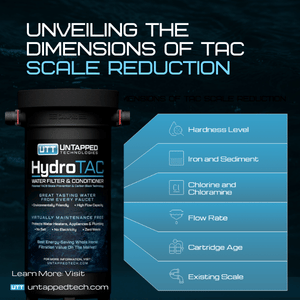 Hardness level. TAC handles very hard water well, but higher hardness minerals leave a slightly larger residual film.
- Iron and sediment. Particulate coats the media and blocks nucleation sites. Our system runs a 20 micron radial flow carbon stage ahead of the TAC stage to catch it.
- Chlorine and chloramine. Both degrade the media over time. That same carbon stage removes them and protects your TAC cartridge.
- Flow rate. The water needs contact time in the media bed. Undersize the system for your home’s peak flow and performance drops. Ours handles 10 GPM.
- Cartridge age. Our TAC cartridge lasts 3 years or 250,000 gallons. The carbon cartridge lasts 1 year or 50,000 gallons. Running past those limits is the most common reason people think their salt free water conditioner quit working.
- Existing scale. TAC prevents new deposits. Conditioned water erodes old buildup slowly, so judge results over months.
Not sure where your water lands in that range? Tell us your hardness number and your peak flow, and we will tell you straight whether TAC fits your water quality or whether you need something else.
Which Appliances Benefit Most From Scale Prevention
Scale insulates. A thin calcium carbonate layer on a heating element forces the appliance to burn more energy for the same output, so scale build up hits your utility bill before it kills the machine. Anything that heats water gains the most.
| Appliance | What Scale Does | Benefit From TAC |
|---|---|---|
| Tankless water heater | Coats the heat exchangers, triggers error codes, shortens life | Highest |
| Tank water heater | Builds on the element, slows recovery, wastes energy | High |
| Dishwasher | Blocks spray jets and coats the heating element | High |
| Washing machine | Deposits in fill valves and hot water lines | Moderate |
| Coffee maker, kettle, ice maker | Visible crust and slower heating | Moderate |
| Fixtures and plumbing system | Crust at aerators and shower heads, narrowing pipes | Moderate |
What TAC Does Not Do
No, TAC will not completely eliminate scale, and we will not claim it does. TAC technology prevents the large majority of scale formation, not every last particle.
Water chemistry varies too much for any salt free system to guarantee a perfect result in every home. If you need complete removal of hardness minerals, ion exchange softeners remain the only technology that delivers it.
It also will not give you soft water in the shower, will not stop every spot on your glassware, and will not strip your existing scale overnight. What it does deliver is 88% to 99% fewer deposits with minimal maintenance, no salt, no water waste, and no loss of the healthy minerals in your water.
One Honest Caveat About Certification
We would rather tell you this than let you find it somewhere else. NSF does not certify salt free conditioners for scale prevention, because the minerals stay in the water and the testing protocols were built around removal. That is why credible numbers come from Arizona State University and DVGW W512 instead of an NSF seal. If a company shows you an NSF scale reduction certification on a TAC unit, it covers something else, usually the carbon stage or a materials safety listing.
Our HydroTAC Whole Home System
We supply the equipment and your own licensed plumber fits it, so you never wait on a service appointment from us. The unit measures 9″ x 9″ x 18″, weighs about 17 pounds, needs no drain and no electrical connection, and ships complete with everything required.
| HydroTAC system | $595 |
| Carbon cartridge, 1 year or 50,000 gallons | $90 |
| Tac cartridge, 3 years or 250.000 gallons | $170 |
| Combo cartridge pack | $250 |
| Antimicrobial cartridge | $119 |
| Flex connector, 2 pack | $36 |
That works out to roughly $189 a year over ten years including replacement media, which still lands below what several competing salt free systems charge for the hardware alone.
The Bottom Line
Arizona State University measured 88% to 97%. DVGW W512 testing shows scale reduction consistently greater than 90%. Our HydroTAC media rates 99.6%, and six competing water conditioners charge between $595 and $1,597 for claims inside that same narrow band.
So how effective is TAC technology at preventing scale buildup on appliances? Effective enough to protect your water heater, your appliances, and your plumbing system without salt, wastewater, or the loss of beneficial minerals, though not quite effective enough to completely eliminate every trace of scale.
Frequently Asked Questions
Is TAC the Same Thing as a Water Softener?
No. Traditional water softeners use ion exchange to remove calcium and magnesium and replace them with sodium ions or potassium chloride. TAC leaves the minerals in place and converts them into crystal structures that cannot form scale. Your hardness test still reads hard after TAC treatment, and that is exactly how it should read.
Will TAC Remove the Scale Already in My Water Heater?
Not right away. TAC prevents new scale buildup first. Conditioned water then erodes existing deposits gradually over several months.
Does TAC Stop Hard Water Spots on Glassware?
It reduces them, but it will not eliminate them. The hardness minerals remain suspended in the water, so they stay behind when a droplet evaporates. Choose a salt based softener if spot free glassware ranks as your top priority.
How Do I Know It Works if the Minerals Stay in My Water?
You check the fixtures, not a test strip. Watch for the absence of fresh crust on shower heads and aerators, and less residue in your kettle and coffee maker over the following months. No water test detects TAC performance, because the technology changes the crystal structure of the minerals rather than the concentration of dissolved solids.
Does a TAC System Waste Water or Require Electricity?
Neither. Salt free systems run no backwash cycle, so they create no waste water, and they need no power or drain connection. That difference is the main reason homeowners pick them over conventional water softeners.
How Long Does the Media Last?
Our TAC cartridge lasts 3 years or 250,000 gallons. The carbon cartridge lasts 1 year or 50,000 gallons. Both swap out in minutes, which keeps the system virtually maintenance free.
Does TAC Reduce Water Pressure?
Not meaningfully in a properly sized system. Ours handles 10 GPM peak flow, which covers a typical household running several fixtures at once.
