
Does Template Assisted Crystallization Require Chemicals Or Salt, And What Does It Cost To Run
No. Template assisted crystallization requires no chemicals or salt. TAC media crystallizes hardness so it cannot stick to pipes. A West Palm Beach family on 18 grain water swapped their softener for a $595 HydroTAC unit, dropped ten salt bags a year, and watched their tankless heater stop scaling. Five year cost lands near $1,595.
Homeowners ask us all the time whether template assisted crystallization requires chemicals or salt, usually right after they finish hauling another bag of sodium chloride down to the basement. The answer is no on both counts.
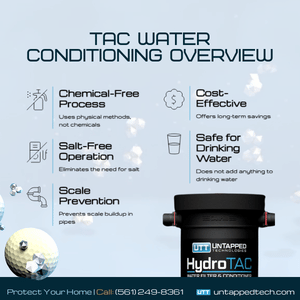
TAC is a physical water conditioning process rather than a chemical one. Water flows through a bed of treated polymer beads, dissolved calcium carbonate converts into seed crystals on the bead surface, and those scale crystals release into the water flow and pass through your plumbing without sticking.
Nothing enters your drinking water and nothing regenerates with brine.
Does Template Assisted Crystallization Require Chemicals Or Salt At Any Stage
A conventional water softener operates on the principle of ion exchange. Resin beads capture calcium and magnesium ions, replacing them with sodium ions; once the resin is saturated, the unit performs regeneration cycles using sodium chloride or potassium chloride.
This is where the salt is consumed. Template-Assisted Crystallization (TAC) completely eliminates this process. TAC media features nucleation sites on the surface of its polymer beads.
When hard water comes into contact with one of these sites, dissolved calcium and carbonates combine to form a crystal seed. This seed grows for a few seconds before detaching and entering the water flow as a stable, suspended crystal.
 Since the ions responsible for hardness are now trapped in crystalline form, they no longer build up as scale on copper piping, heating elements, or plumbing fixtures. As the media serves merely as a substrate, it is not consumed by the reaction and therefore requires no regeneration.
Some manufacturers refer to this same process as nucleation-assisted crystallization. Both terms describe an identical chemical process.
- No Sodium Chloride: No brine tank, no bags to carry, no monthly refill.
- No Chemical Feed: No phosphate, no acid, no potassium chloride, no additives.
- No Electricity: No control valve and no energy use at the point of entry.
- No Brine Discharge: No regeneration cycles, so nothing drains to a sewer or septic field.
What Happens Inside A TAC Tank
- Water enters the tank. Hard water, laden with dissolved calcium and magnesium ions, flows through the filter bed at a normal flow rate.
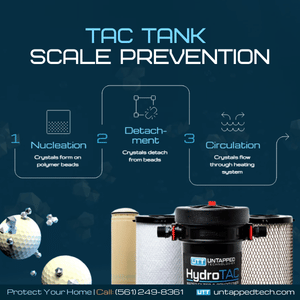 Crystals form. Nucleation sites on the polymer beads trigger the crystallization of calcium carbonate, causing it to transition from a dissolved state to solid microcrystals.
- Crystals detach. Once a crystal reaches its maximum size, the water flow detaches it from the bead in approximately five seconds.
- Limescale does not adhere. The suspended crystals circulate through water heaters and heating systems as soft scale—which can be rinsed away—rather than hard scale that bonds to the metal.
This explains the effectiveness of TAC systems in protecting hot water equipment. Heat accelerates scale formation; consequently, in untreated homes, water heaters and instantaneous heating systems accumulate the greatest amount of scale.
Once the hardness-causing minerals have crystallized, the hot water no longer causes new scale deposits to form on the heating elements.
What Salt Free Scale Prevention Actually Costs
We priced every well known whole house TAC system on the market in September 2026 and built a five year model around a four person household on 15 grain water. Nobody else in this category publishes the math, so here it is.
What You Have Spent By Year Five
Cumulative cost of ownership for a four person household on 15 grain water. Lower is better.
Consumables annualized across five years. Softener figures include salt, regeneration water, and control valve energy use.
The finding. HydroTAC enters at $595, roughly 62 percent below the $1,556 category average for comparable TAC units. Buyers keep $961 in their pocket compared with the cheapest name brand rival, and the capital costs stay low from day one.
Five Year Cost Of Ownership
| System | Upfront | Consumables Over 5 Years | Salt Over 5 Years | Five Year Total |
|---|---|---|---|---|
| HydroTAC | $595 | $1,000 | $0 | $1,595 |
| Category low TAC brand | $1,452 | $175 | $0 | $1,627 |
| Salt based water softener | $1,200 | $150 power and water | $360 | $1,710 |
| Mid range TAC brand | $1,588 | $200 | $0 | $1,788 |
| Category high TAC brand | $1,595 | $233 | $0 | $1,828 |
HydroTAC finishes lowest over five years at $1,595, and it gets there while asking for the smallest amount of money up front. Maintenance costs stay predictable because the only consumables are the carbon and TAC replacement media cartridges, and there is never a salt line item.
How We Built These Numbers Four-person household, water hardness of 15 grains per gallon, and consumption of approximately 300 gallons per day. Competitor prices were recorded in September 2026 based on manufacturers' catalogs and major retailers. The cost of salt for the softener is calculated based on bi-weekly regeneration using 8 pounds per cycle, with a salt price of approximately $9 per 40-pound bag. Plumbing labor costs are excluded, as they apply equally to all systems.
TAC Systems Compared To Ion Exchange Water Softening
| Factor | TAC Units | Salt Based Water Softener |
|---|---|---|
| Salt required | None | Roughly 400 pounds per year for a family of four |
| Chemicals | None | Sodium chloride or potassium chloride |
| Electricity | None | Control valve draws power around the clock |
| Brine discharge | None | Roughly 3,900 gallons per year to drain |
| Effect on water hardness | Hardness stays in the water as harmless crystals | Removing calcium drops hardness to near zero |
| Drinking water impact | No added sodium, minerals retained | Adds sodium, strips dissolved calcium |
| Slippery feel | No | Yes, the classic soft water feel |
| Total dissolved solids | Essentially unchanged | Shifts as calcium trades for sodium |
| Environmental benefits | No brine, no wasted water, no energy use | None on any of the three |
- 0 lbs- Salt HydroTAC uses per year
- ~400 lbs – Salt a comparable softener uses yearly
- 0 gal – Brine discharge per year
- ~3,900 gal – Regeneration water a softener drains yearly
Neither approach is wrong. If you want genuinely softened water with the slippery feel and spot free glassware, ion exchange is the only technology that delivers it, because it physically removes hardness.
If your goal is scale prevention with lower capital costs and real environmental benefits, TAC does that job without touching your water chemistry.
Salt Free Does Not Always Mean Chemical Free
Consumers are often misled in this area, so we want to be direct: many products marketed as “salt-free” water conditioners actually add substances to the water.
Polyphosphate sequestration systems dose a chemical that keeps hardness-causing minerals in suspension; this supply is depleted over time and requires replenishment. Ultimately, these are chemical-based systems labeled as “salt-free.”
At the opposite end of the spectrum is electromagnetic water treatment. This method adds no substances, but laboratory tests show its performance to be far below that of TAC technology.
An evaluation of alternative technologies conducted by Arizona State University recorded a scale reduction of over 88% with the TAC device analyzed, whereas electromagnetic and electrically induced precipitation devices achieved results close to 50%.
Scale Reduction By Technology
Arizona State University evaluation of alternative scale control technologies.
Results vary with water quality, so alternative technologies perform to varying degrees depending on hardness, pH, and total dissolved solids.
- 88%+ – Scale reduction from TAC in ASU testing
- ~50% – Electromagnetic water treatment in the same study
- ~5 sec – Contact time TAC needs regardless of hardness
- 62% – Lower entry price than the category average
Water quality changes the outcome, so alternative technologies perform to varying degrees depending on hardness, pH, temperature, and total dissolved solids. That is why we ask for your numbers before recommending anything.
What Salt Free TAC Cannot Do
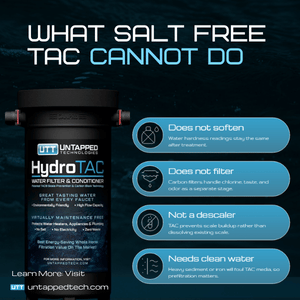 We would rather set honest expectations than oversell a system. Because TAC never removes calcium and magnesium, your water still tests hard on a strip. You will still see spotting where droplets dry on glass. TAC also does not filter contaminants on its own, and it will not handle iron or hydrogen sulfide.
- It does not soften. Water hardness readings stay the same after treatment.
- It does not filter. Carbon filters handle chlorine, taste, and odor as a separate stage.
- It is not a descaler. TAC prevents scale buildup rather than dissolving existing scale, though many homeowners watch old scale accumulation loosen and clear over several months.
- It needs clean feed water. Heavy sediment or iron will foul TAC media, so prefiltration matters.
Who Salt Free Water Conditioning Suits Best
- Homes subject to salt discharge restrictions, which cover much of Southern California and a growing list of municipalities.
- Properties with septic systems where brine discharge causes issues.
- Households that wish to retain minerals in their drinking water.
- Tankless water heaters and high-efficiency heating systems prone to premature failure due to scale buildup.
- Water entry points that lack a nearby drain or outlet.
- Homeowners who want to prevent scale buildup without the need for monthly salt purchases.
Water hardness varies significantly by region. Geological maps place much of the Southwestern U.S., Texas, and Florida in the hard to very hard water range, explaining why scale control is such a common issue in those markets.
Key Takeaways
- No salt and no chemicals. Template assisted crystallization uses treated polymer beads to crystallize hardness, so it needs no sodium chloride, no potassium chloride, and no chemical feed.
- Nothing enters your drinking water. The reaction never consumes the TAC media, so total dissolved solids stay essentially unchanged and no sodium is added.
- It prevents scale rather than softening water. Calcium and magnesium ions stay in the water as microscopic crystals, so hardness readings do not drop.
- Independent testing shows better than 88 percent scale reduction for TAC, against roughly 50 percent for electromagnetic water treatment in the same Arizona State University evaluation.
- HydroTAC enters at $595, roughly 62 percent below the $1,556 average entry price of comparable whole house TAC systems we surveyed in September 2026.
- Five year ownership lands at $1,595, lower than every salt free rival we priced and lower than a salt based softener at $1,710.
- Zero brine discharge. A comparable softener sends roughly 3,900 gallons of regeneration water to drain and burns through about 400 pounds of salt each year.
- Not every salt free product is chemical free. Polyphosphate sequestering systems dose an additive that runs out and needs refilling, while TAC adds nothing at all.
The Bottom Line On Salt Free Scale Prevention
If you are weighing scale control options and still wondering does template assisted crystallization require chemicals or salt, the answer holds in every system we supply, which is no salt, no chemicals, no electricity, and no brine discharge.
Frequently Asked Questions
Does TAC Put Anything Into My Drinking Water
No. TAC media provides a surface for crystals to form and the reaction never consumes it, so nothing leaches into the water molecules passing through the tank.
Does TAC Need Salt To Regenerate
No. TAC runs no regeneration cycles at all, which is why a TAC tank has no brine tank, no timer, and no drain connection.
Is TAC Safe For Septic Systems
Yes. A TAC unit never regenerates, so it sends no brine discharge to a septic field. This ranks among the most common reasons our customers switch.
Does TAC Remove Calcium And Magnesium
No. Removing calcium requires ion exchange. TAC leaves the hardness ions in the water and changes their form so they cannot form scale.
How Much Does A TAC System Cost To Own
Our HydroTAC system starts at $595, against a $1,556 average for comparable whole house TAC units. Over five years, including replacement media, we model total ownership at $1,595 with no salt line item at all.
How Long Does TAC Media Last
Media life depends on the product and on how well the water is prefiltered. We point customers to the replacement media guidance for the exact system they own rather than quoting a general industry figure.
Will TAC Remove Existing Scale
TAC is built to reduce scale formation going forward. Homeowners often report existing scale deposits softening over time as treated water passes through, but we do not sell it as a descaling product.
